Friday, 7 November 2014

Kuleshov and Pudovkin's theory in practice


Kuleshov and Podovkins theories as mentioned in the previous post is applied to many films today. An example is from the Classic Hollywood film Bonnie And Clyde (1967), this film was apart of the 60s New Hollywood era which many believe shaped the future of films today and broke many so called "rules" in doing so.

Films prior to this era in editing terms used to follow a "dance" when cutting a scene together. For example a conversation scene would begin with a wide, cut to an over the shoulder, then the same for the other character followed by continuous shot reverse shot singles.

Podovkins theory has been applied to a scene in Bonnie and Clyde (1967). The scene in which Bonnie is questioning whether Clyde is who he says he is (an armed bank robber) so he pulls out his gun to prove it to her, there are simultaneous cuts between close ups of Bonnie and the gun until she strokes his gun in a sexual manner, it then cuts to Clyde's reaction in which he is smirking as she would now believe him. This cutting back and fourth from an object in juxtaposition, in this case the gun, causes the audience to make a psychological connection between Bonnie and the gun as without her saying a word, it is clear that she envies the power and swagger of carrying the gun.


Thursday, 6 November 2014

Object Interaction in "See You Soon"


due to See You Soon having few characters, a way of developing characters would be their interactions with objects as a lot can be told from cutting back and forth from the subject and an object based on the symbolism of the object.


This technique derived from Russian filmmaker Lev Kuleshov (13 January1899 – 29 March 1970). His theories and experiments have contributed to shaping the way films are edited today. one of his theories was that emotions from a character could be exposed by an object based on their order and juxtaposition. this theory was tested by Lev Kuleshov in the 1910s and 1920s which was known as The Kuleshov Effect. For this experiment a close up of an actors face is shown this then cuts between a bowl of soup, back to the actor, to what appears to be a dead girl, back to the actor then to a woman laying down and then the cycle repeats. When screened to an audience, they raved about the actors performance however his expression did not change throughout the duration. This shows that splicing these objects in-between the close up of the actor based on there order caused the audience to make a psychological connection between each object and the actor. 


The video below is a great essay on how Vsevolod Pudovkins theories are applied to Hollywood films today. he is also a Russian film theorist who claimed to have been apart of the The Kuleshov Effect.


C300 Workshop Notes


This workshop  was very useful as I got a hands on experience of setting up and resetting the Canon C300  for the best results when shooting. Usually I wouldn't need to take a workshop on setting up a camera as I wouldn't usually operate the camera on set however last semester our cinematographer was ill so I had to work a lot with the camera.

I managed to shoot some footage in C-LOG in order to take home some rushes to practice what I have learnt so far with colour correcting.  I am practising colour correcting in Avid Symphony but this will also be a run through of the workflow I intend to use in terms of importing the .mxf files using an ama link as well as exporting the graded footage in a 1920 x 1080/50i DNxHD format.


See You Soon Pre Vis


The group had a pre vis on location in which we took a Canon 7D and took stills of shots from the shot list, this was helpful to get used to the space and the limitations around the house. I have been given the images to put a simple pre vis edit together just to get a vision of how the shots will connect to one another. Also to give me an idea of the order the shots will be in for when it comes to the real edit. 


Overlaying Tracks "The Horse Whisperer"


Oscar winning editor Tom Rolf (December 31, 1931 – July 14, 2014) as pictured below is known for his editorial work on films such as Heat (1995) , Taxi Driver (1976), Equilibrium (2002) and many more. however it is his editorial work on The Horse whisperer which I have been most inspired by, especially for the See You Soon project.


See You Soon tackles a mother and a teenage daughter relationship which involves an argument over the mother turning off the daughters music for it being too loud (temporarily in script). In The Horse Whisperer there is a scene in which Robert MacLean (Sam Neill) and his wife Annie MacLean (Kristin Scott Thomas) are arguing in the kitchen as their marriage starts to deteriorate. 

they were both recorded with separate microphones which meant they had their own individual tracks when it came to post production. so when in the editorial stage the two audio tracks were overlapped to which meant there was less of the atmospheric air track causing the two to interrupt and shout over one another. At times this also caused the pace of the cuts to build in order to keep up with the lip syncing. This overall gave more of a hectic whist realistic feel to the scene rather than each actor giving their lines accordingly. This is definitely a technique to consider in post production if the actresses for See You Soon are each micro-phoned up or recorded at different moments in time.  


Transitioning through time and space continued...


an Director/editor who's work I find highly inspirational is Anime editor Satoshi Kon. what i found most interesting was the transitions he creates to get from one scene to another, especially in the (2006) animated film "Paprika". This film is about a dream machine in which therapists use to enter patients dreams gets stolen. the film begins with Detective Toshimi Konakawa unintentionally travelling between 4 different levels of a dream, the transitions between each of these levels are what I found interesting.

each transition is different between each level of the dream. The first is a POV of the detective swinging represented by the moving camera into the whirling plate which is then blurred into the next scene which turns into a motion blur of the detective continuing to swing but through the trees of jungle. This transition of blurring two scenes together is mostly used if either the camera or subject is in motion meaning the blur can seamlessly hide the cut as if it is motion blur deriving from either the character or the camera.


The second transition is a simple cut but it relies on the actions going on within the scene. Detective Toshimi Konakawa is hit by a rope which slightly wraps across his neck this then cuts to the next level of the dream in which someone is strangling him with a wire.


The third transition is a match cut which cuts as Paprika hits the strangler with a briefcase, this cuts a few frames before impact to a guitar in the third level of this dream. Similar to the first transition, this transition relies on the characters movement to create the seamless cut.


The transition to the final level of this dream is very dramatic which is most likely why it has been used for the last transition. as the detective runs through the door the background fades to black leaving just him and his reaction in a close up, there is then a cut to a high angle wide revealing the last level of the dream. similarly to the 2nd transition, this relies on the characters actions however this is enhanced in this transition with the background fading to black forcing the audience to focus on the characters emotions seconds before the reveal of what the character is looking at from the wide. 


Satoshi Kon also used transitions focusing on objects rather than characters and motions which are more related to the transitions we are likely to have in the See You Soon project. 


for this transition a lorry drives into the frame which is used as a screen wipe and is merged with someone walking past frame in the next scene to create a seamless wipe effect using objects within the scene. This is used a lot in live action films, especially through walls to another room. Edgar Wright is a director who likes to use this transition in a lot of his films as seen below.


another transition which is also highly relevant to the See You Soon project is another of Satoshi Kon's signature transitions which is again to match two scenes by focusing on an object rather than a character in both scenes, however the objects connect in this transition whether they're in both or appear to be in both scenes. for example the transition below match cuts a blood dripping to the drip landing in a puddle of blood in the next scene.


Satoshi kon

This is a great breakdown of the works of Satoshi kon, an anime editor who is known for his innovative transitions and editing style.


Transitioning through time and space


There are many ways in which film makers transition from one time zone to another whether its a flashback or a simultaneous event. I have researched the way in which editors use match cuts, blending two moving camera shots to create one flowing shot and other interesting ways of transitioning from one location or time to another.

SHUNPO - Directed by Steven Briand 
This short film plays with the idea of escaping a daily routine by adding movement into our lives through dance, however this is portrayed in a sci-fi type way in which within one step the dancer can be in a location miles away. This choreographed dance piece uses match cuts to transition between each location.


Due to this piece focusing on the dancers choreographed movements, the cuts occur whilst she is in mid motion like the example above. As she swings her jacket the cut occurs with the motion proceeding onto the next location. This is effective as the audience will be focusing on her movement so as she is in mid motion there will be motion blur which makes the transition much smoother allowing the dancer to seamlessly have "teleported" to the next scene . 


for the cuts where two of the same shots matched e.g. a wide to a wide, the dance would have to be near enough in the same identical position in terms of framing the two shots to match one an other. there are many ways to do this; firstly a green-screen which would mean that the dancer could do most of the dance if not all at one location however, due to her interaction with each location it is clear this was not green screened. So either these film makers must have shot the film in 2K/4K which would give the advantage of being able to tighten and align the image in post-production to match the framing up for each shot without loosing any quality. However this film was shot using a Canon 5D mark iii so these resolutions would only be achievable using the magic lantern hack.  Another method which could have been used is a feature called ghost imaging which enables the camera operator to view a frame from previous shot overlaying the live view through the viewfinder. This would also enable the framing to be matched up accurately on set without having to realign in post production, although this may also have required the magic lantern hack.

This film is very inspiring from an editors point of view due to the smoothness of the match cuts and the timing of the cuts themselves. However the project I am editing (See you Soon) is a narrative film which means that I am unlikely to be cutting on a characters motion, but instead the objects the character interacts with will most likely be the focus of the match cuts in See You Soon. Although the technique can still be applied in terms of the framing and timing of the cuts.  

Wednesday, 5 November 2014

Colour Correction research


I have began researching colour correction which is one of my roles for See You soon. Here are some notes on the book Color correction for video: using desktop tools to perfect your image / by Steve Hullfish, Jaime Fowler:


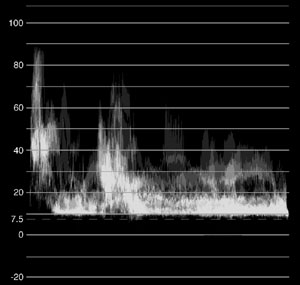
Blacks are also known as shadows,pedestal,set-up or lift depending on the application

Legal black level is either 0.0 or 7.5 NRE depending on the system


An easy way to tell what the black level is for your system is to feed "filler" (black signal the system generates when there is no video) to the waveform monitor.


With the brightest and darkest parts of the image judged by legal levels, the gamma or midrange is the tonal range that can be set to ensure the shot has its true overall tone.

"Think of your tonal range as a rubber band."

Once tonal range is set, the next step is to balance the colours.

Black white and grey are exactly in the middle of the vectorscope which means they have no saturation.


The focus of the Colour balancing stage is making to ensure that the colours that are supposed to be neutral, are neutral.

"Equal levels of red, green, and blue means there is no saturation."

gamma response of a computer display is different from a TV set or video monitor.

Setting your monitor to black and white is a way you can refresh your perspective.

computer LCD screens should be set to a 2.2 gamma setting and should use D65 standard for white.

"Parade displays are as important in obtaining chroma information as luminance information."

Ensure the colours you are trying to balance are actually neutral.

See You Soon role


after a few meetings I have now been Given my roles for the See You Soon (working title) short narrative film. I can now start researching into editing styles for inspiration on this film, especially films which deal with lost ones, flashbacks, match cuts and playing with time and space which is what his film will be dealing with.


Editor
- VFX
- Colour Correction
- Continuity Supervisor
- Clapper

Monday, 3 November 2014

Structure For 3D Film

Based on feedback from a few tutorials weve had, it has been made clear that the side "video game" project needs to have more depth and narrative. So after a few meetings with Al we have started to develop a plot.


Story
A 3D narrative piece set in the point of view of a robot who wakes up in a scrap yard trying to understand who he is, what his purpose is, and why he has woken up in a scrap yard. The robot discovers many clues through human artifacts which are pieced together to reveal that he has in fact been reset, banished and replaced by a greater advanced model. The story follows the robot on his mission to escape the derelict area and return to civilisation.

Origins
            The film tackles how society has become superficial in the way we adapt to new technology by throwing away the old in an endless cycle of obsessively keeping up with the latest trends and technological advancements. Also that the belongings we currently own are just a temporary component in a continuously rejuvenating society. 

Inspirations

First person video games as a whole, a great deal of FP games feature cutscenes in which the audience sit back and watch their character move freely without their control, even though this may not be as immersive as the player controlling them it is used in a great deal of first person games as an establishing shot in which the player/audience is introduced to the surroundings and interactive objects before they start playing. this method of spectating a character through their POV is what we will be using for this film with the use of camera shakes, pans and tilts to replicate the robots head movement.    

Fallout 3 - this video game is based in a post apocalyptic world which has been ravaged by nuclear war. It is this style of a deserted wasteland terrain which our film will be based on.

Wall-E - similar to the inspirations we received from Fallout, Wall-E is also mostly based in a post apocalyptic world however in this film there is a higher attention to detail on the reflection on the world prior to this apocalypse e.g. Wall-E discovers footage of the musical film “(Hello, Dolly!)” which relates back to 1969 (pre apocalypse) these are the type of interactions with sentimental artifacts which our protagonist will experience.

Sight - this short film is based on a futuristic device which allows humans to see a virtual hud and operating system overlaying real life in which one can gain experience points and level up (like a video game) by completing real life activities e.g. cookery. It is the style of the HUD which appealed to us the most as almost everything of significant worth is labeled with a display which tracks the object/subject whilst providing information.


technical workflow
  • Shooting with two cameras set on identical settings for the left and right channels for 3D
  • workflow in premiere and After Effects
  • Heavily reliant on foley sound recording
  • stereo sound recording and editing
  • filming techniques

Notes:

computational regime - how we became posthuman.
patchwork girl
black mirror - on netflix


“smack my bitch up” - music video.

3D Tests


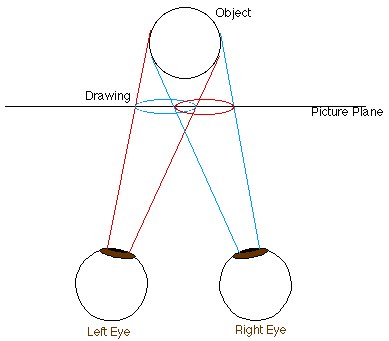
I ran some tests with intentions of creating a 3D anaglyph in mind with Al today. we setup two Canon 600D's next to one another on tripods with identical settings on WB, Iso, shutter speed etc in order to get accurate red and blue channels. we shot a short walk towards the camera to get a sense of how the depth will turn out when displayed in 3D.